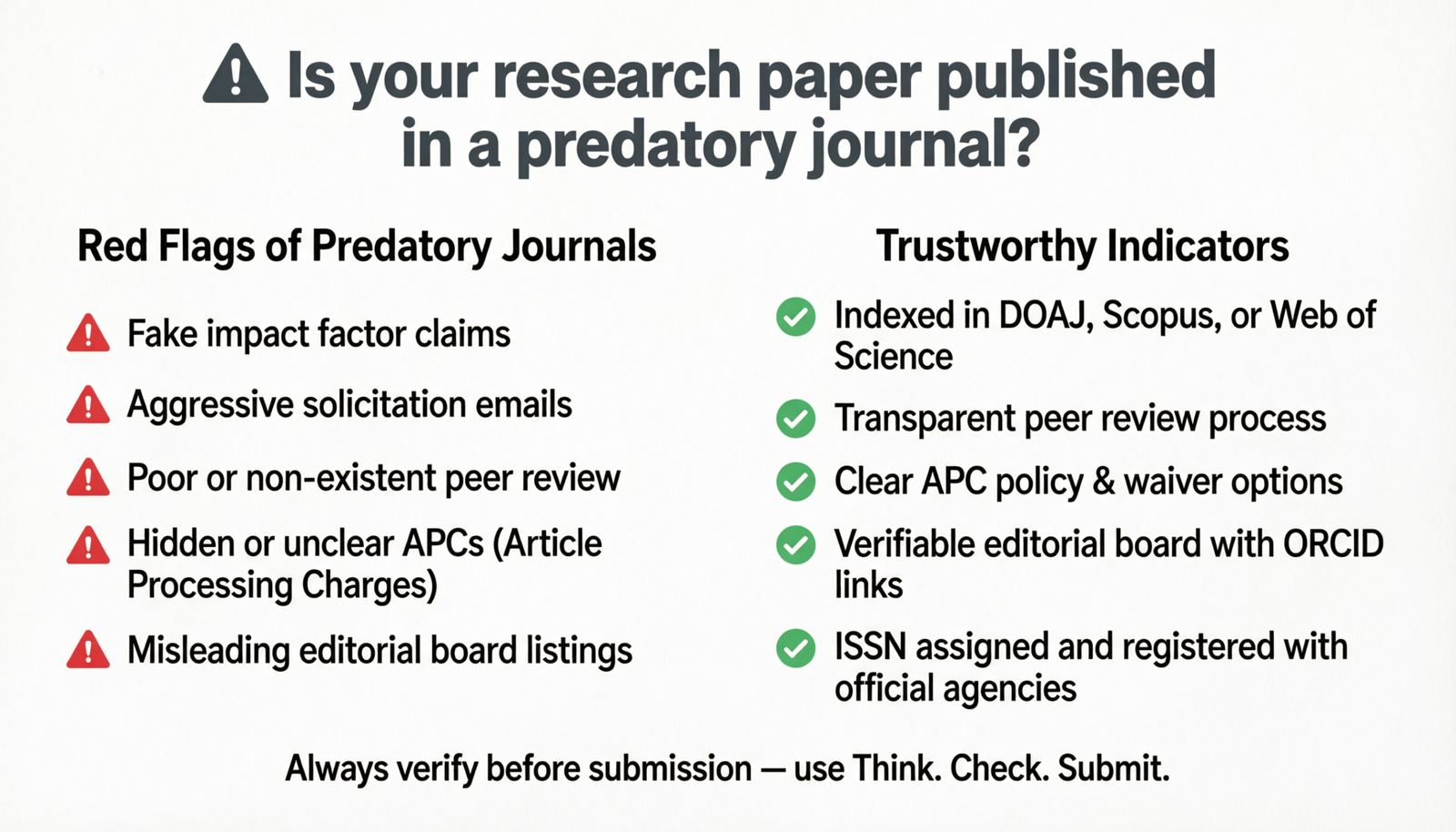
Predatory Journals: How to Identify Fake Academic Journals Before You Submit Your Research
Protect Your Research from Predatory Publishers
Publishing a research paper is one of the most important milestones in an academic career. Whether you are a PhD scholar, researcher, faculty member, or scientist, your work deserves recognition in a credible, peer-reviewed journal.
Unfortunately, thousands of researchers lose valuable time, money, and academic credibility by submitting their manuscripts to predatory journals. These journals often promise rapid publication, charge expensive article processing charges (APCs), and provide little or no genuine peer review.
If you’re planning to publish in a Scopus-, Web of Science-, or PubMed-indexed journal, understanding how to identify predatory publishers is essential.
What Are Predatory Journals?
Predatory journals are deceptive publishing outlets that prioritize profit over academic quality. They often imitate legitimate scholarly journals but fail to provide the editorial standards, transparent peer review, and ethical publishing practices expected in reputable academic publishing.
Unlike legitimate journals, predatory publishers frequently:
- Accept manuscripts with little or no peer review.
- Charge publication fees without providing editorial services.
- Misrepresent indexing claims.
- Display fake impact factors.
- Could you list editorial board members without their permission?
Publishing in such journals can damage your academic reputation and reduce the visibility of your research.
Why Publishing in a Predatory Journal Is Risky
Choosing the wrong journal can have long-term consequences.
1. Your Research May Lose Credibility
Many universities and funding agencies do not recognize publications in predatory journals during promotions, grant applications, or academic evaluations.
2. Limited Visibility
Predatory journals are rarely indexed in respected databases such as:
- Scopus
- Web of Science
- PubMed
- MEDLINE
- Embase
Without indexing, your research becomes difficult for other researchers to discover and cite.
3. Poor Peer Review
Quality peer review improves research by identifying methodological weaknesses, statistical errors, and reporting issues.
Predatory journals often skip this process entirely.
4. Financial Loss
Researchers frequently pay substantial publication fees only to discover that their article appears in a journal with little academic value.
5. Damage to Academic Reputation
Publications in questionable journals may negatively affect:
- Faculty promotions
- PhD thesis evaluations
- Research funding
- Institutional rankings
- International collaborations
Warning Signs of a Predatory Journal
Before submitting your manuscript, watch for these common red flags.
1. Unrealistically Fast Acceptance
If a journal promises acceptance within 24–48 hours, proceed with caution.
A genuine peer-review process typically takes several weeks or months.
2. Fake or Missing Indexing Claims
Could you verify whether the journal is genuinely indexed?
Predatory journals often falsely claim inclusion in:
- Scopus
- PubMed
- Web of Science
- DOAJ
Please don’t rely solely on the journal’s website.
3. Suspicious Editorial Board
A legitimate journal clearly lists:
- Editor-in-Chief
- Associate Editors
- Editorial Board Members
- Institutional affiliations
Could you verify whether these individuals actually exist and are associated with the journal?
4. Poor Website Quality
Common warning signs include:
- Broken links
- Numerous spelling mistakes
- Missing publication policies
- No contact address
- Generic Gmail or Yahoo email addresses
Professional publishers maintain transparent and well-designed websites.
5. Aggressive Email Invitations
Have you ever received an email saying:
“Dear Esteemed Researcher, your excellent previous work qualifies you for immediate publication.”
These mass emails are a hallmark of predatory publishers.
Legitimate journals rarely send unsolicited invitations promising guaranteed publication.
6. Fake Impact Factors
Only trust recognized journal metrics, including:
- Journal Impact Factor (Clarivate)
- CiteScore
- SCImago Journal Rank (SJR)
- Source Normalized Impact per Paper (SNIP)
Avoid journals advertising obscure or self-created impact metrics.
How to Verify Whether a Journal Is Legitimate
Before you turn in your manuscript, please follow this checklist.
Verify Indexing
Confirm the journal’s presence in:
- Scopus Source List
- Web of Science Master Journal List
- PubMed
- Directory of Open Access Journals (DOAJ)
Review Previous Articles
Read recently published papers.
Ask yourself:
- Are they scientifically sound?
- Do they include proper citations?
- Are the authors affiliated with recognized institutions?
Check the Peer Review Policy
A legitimate journal clearly explains:
- Review process
- Average review time
- Ethical guidelines
- Editorial workflow
Examine Publication Ethics
Look for compliance with recognized publishing standards, including:
- COPE guidelines
- Publication ethics policies
- Retraction procedures
- Conflict-of-interest statements
Evaluate the Publisher
Research the publisher’s history.
Reputable publishers maintain transparency regarding:
- Contact information
- Editorial policies
- Copyright
- Licensing
- APCs
Common Myths About Predatory Journals
Myth 1: Open Access Means Predatory
False.
Many respected journals are fully open access while maintaining rigorous peer review.
Myth 2: High Publication Fee Means High Quality
False.
A high APC does not guarantee journal quality.
Always evaluate editorial standards rather than cost.
Myth 3: Quick Acceptance Means Efficient Publishing
False.
Rigorous scientific review takes time.
Acceptance within a day or two often indicates little or no peer review.
Best Practices Before Journal Submission
Before submitting your manuscript:
- Could you identify journals matching your research scope?
- Verify indexing status independently.
- Could you check journal metrics?
- Please read the author guidelines carefully.
- Review recently published articles.
- Confirm peer-review procedures.
- Could you assess the publisher’s reputation?
- I’d like you to please seek advice from experienced researchers if they are unsure.
A few hours of verification can prevent months of frustration.
Final Thoughts
Your research represents months—or even years—of dedication. Choosing the right journal is just as important as conducting quality research.
Predatory journals continue to exploit researchers through misleading claims, fake indexing, and inadequate peer review. By carefully evaluating a journal’s credibility before submission, you can protect your work, enhance its visibility, and strengthen your academic reputation.
You can invest time in selecting a reputable journal, verify every claim independently, and publish where your research will have a genuine scientific impact.
Mallari Praveen, I will assist researchers in identifying suitable journals, evaluating journal quality, interpreting indexing claims, and selecting publication venues that align with their research goals and academic standards.
Your research deserves to be published where it can be trusted, discovered, and cited.